1300 367 412




Picture this scenario: You’re in a room with dozens of real estate agents. The presenter asks who has a GCI goal. Every single hand shoots up, as expected. Then comes the next question: “Who knows exactly how many properties you need to sell to hit that number?” About half the hands drop.
By the time the questioning reaches “How many updates do you need to send per week?” only five hands remain in the air.
There’s often a fundamental disconnect between goals and the daily activities that generate them. Most agents know what they want to earn. Very few understand the mathematical formula that gets them there.
GCI, or Gross Commission Income, is the total commission you earn before splits, fees, and expenses. It’s the standard measure real estate agents use to set income goals. Regardless of your GCI goal, the principle of reverse-engineering that goal into daily activities remains the same.
Now, what if someone told you that a task taking three to four minutes could be worth over $500 to your business? Whether it converts immediately or not. That’s the economic reality of Realtair’s Market Updates when you understand the numbers behind them.
Working backwards from the goal
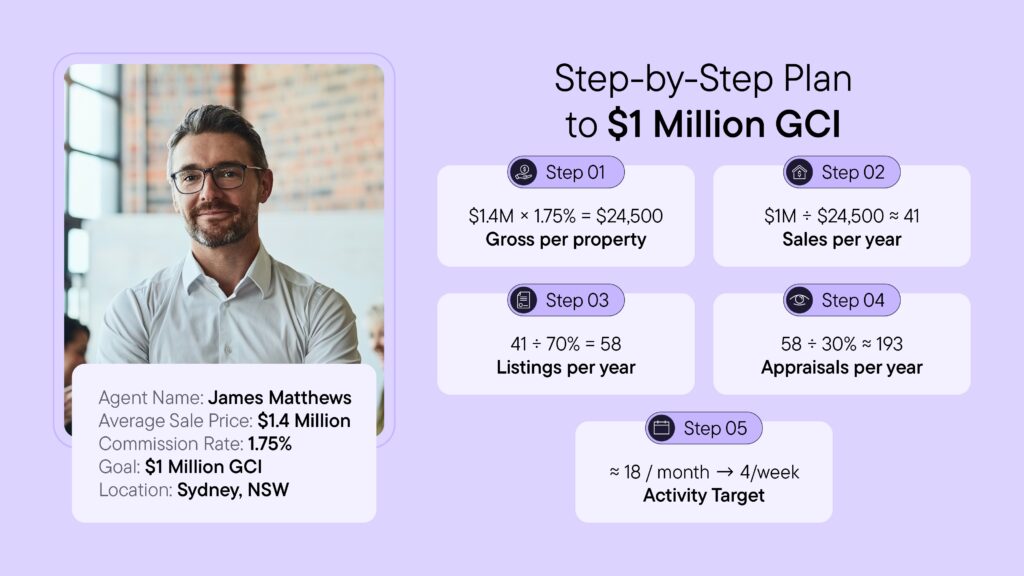
Meet James Matthews, a sales agent targeting $1 million in GCI for the first time. It’s a goal many agents share. Whether you’re aiming for $200K as a new starter, $1M as an experienced agent, or $5M as an office, the principle remains the same. Only the underlying metrics shift.
Step 1: To break down the GCI into an actionable target, you need to start working out how to get to that number. The top two pieces of data you need:
- Average sale price
- Your commission rate
These figures let you calculate GCI per property. For this example, we’ll use Sydney averages:
- Sale price: $1.4 million
- Commission: 1.75%
The calculation is straightforward: $1.4 million × 1.75% = $24,500 gross per property.
Step 2: Divide your GCI goal by the average GCI per property.
$1 million ÷ $24,500 = 41 properties needed to hit the goal in a year.
Starting at 41 properties per year feels daunting. But breaking it into smaller timeframes makes it more manageable:
- Monthly target: ~3-4 sales
- Weekly target: ~1 sale
Running on sprints of weeks, months, or quarters keeps the goal within reach.
Step 3: Factor in clearance rates.
If James’s clearance rate is 70%, he can’t aim to list only 41 properties.
With a 70% success rate assumed here, James needs to list 58 properties to achieve 41 sales. Planning to list only 41 when you need to sell 41 leaves you short. These 58 listings break down easily into monthly, weekly or quarterly targets.
Step 4: Work backwards to appraisals.
Now we’re building the activity numbers that matter. Listings come from appraisals. Industry standards suggest around 30% of appraisals convert to listings — about one in three.
So, to secure 58 listings:
- James needs 16 appraisals per month
- Or four a week
These are the true activity numbers. Having a million-dollar GCI goal means nothing if you don’t know the daily actions required to achieve it.
Understanding these numbers matters whether you’re an individual agent or managing a team. If you’re leading associates, their target is booking these appraisals, which drives everyone towards the goal. Bring your team along on this journey so everyone understands the numbers, whether it’s an agent goal, team goal or office goal.
The Market Update question
With appraisal targets in place, the next step is working out what’s needed from a Realtair perspective.
While we’d love to see conversion rates above 30% because Realtair Pitch generates compelling proposals that outperform competitors, the priority is simple: get in front of as many potential sellers as possible.
Why Seven Market Updates a day
Our modelling shows that seven Market Updates daily is the sweet spot. Here’s the reasoning:
Each Market Update carries an average long-term statistical value of ≈$500, even if it doesn’t convert immediately. The $500 figure* comes straight from the conversion maths:
- 10% of Market Updates convert to an appraisal (Realtair data, 1M+ Market Updates in 2024)
- 30% of appraisals become listings
- 70% of listings sell
- $24,500 GCI per sale in our example
Multiply those rates together, and you get ≈$500 per Market Update in long-term statistical value.
Lead nurture over time
This doesn’t mean one in seven Market Updates will instantly convert to an appraisal. In reality, vendors often need multiple reports over several quarters before they’re ready to sell. You’re nurturing leads over time. But the maths holds: seven daily Market Updates → appraisal pipeline → consistent GCI growth.
Thirty minutes a day covers seven Market Updates. Scaling to 20-30 updates requires roughly 1-1.5 hours, assuming your contact list is ready.
*$500 assumes all appraisals from Market Updates
The GCI Calculator
To make this process simple, we’ve built a GCI Calculator to simplify the maths. You only need four inputs:
- Commission target
- Average sale price
- Commission rate
- Clearance rate
Everything else auto-calculates. This simplicity is intentional because achieving goals shouldn’t be complicated. We often overcomplicate the path to our targets.
The calculator generates your prospecting plan, factoring in Market Updates, open home follow-ups, letterbox drops, and other prospecting activities.
The 10% Market Update conversion rate is the only figure backed by Realtair’s own data, drawn from over a million Market Updates sent last year and their progression to appraisals. All other conversion benchmarks use industry averages.
At 10% conversion with 50% of appraisals from Market Updates, we arrive at seven daily Market Updates. This is your target number. Adjusting the GCI goal to $2 million simply doubles all activity metrics. The maths scales straightforwardly.
Comparing the ROI
Spending three to four minutes on a task that statistically returns over $500 is an exceptional ROI. This outperforms letterbox drops and doorknocking significantly.
Those traditional methods remain valuable, but time is finite. The key is prioritising high-return actions and layering them into a multichannel prospecting strategy. Market Updates should be a core component of your strategy.
1. The tracking advantage
Think about letterbox drops — they leave you guessing. Did the flyer land in the bin, or on the fridge? You’ll never know.
Market Updates change that with visibility through real-time open notifications. And when sent via text (with higher open rates than email), engagement soars even further.
When a prospect opens your report a week after receiving it, perhaps while discussing their property on a Sunday evening, you receive an alert. That’s your cue to call. It’s like knowing someone pulled your letterbox drop from the pile and pinned it up, except you actually get notified.

2. The personalisation edge
Generic office newsletters rarely stand out. They feature properties that may not be relevant and often feel like mass marketing.
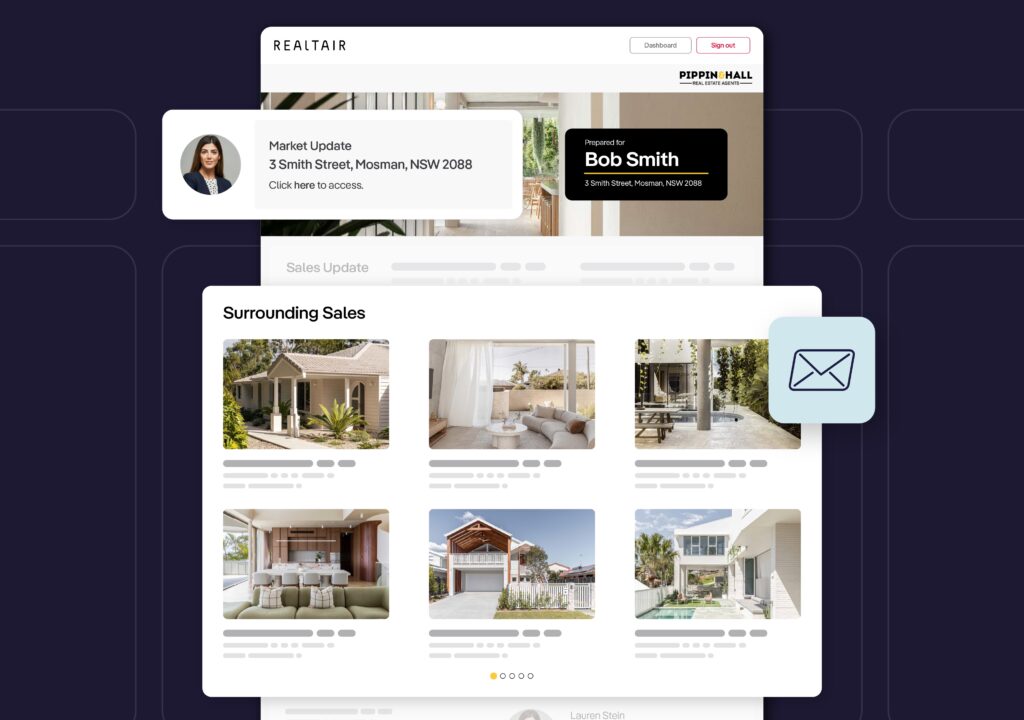
Realtair’s Market Updates differ through personalisation:
- Addressed to the recipient by name
- Focused on the recipient’s own property
- Includes comparables from their immediate area or similar properties
This personalisation makes your Market Updates stand out. Every contact should receive them. Sold to a new buyer? Add their property to a Market Update immediately. Keep them informed about their area’s market activity.
They might not sell for two, five or ten years. But when they do, and you’ve maintained quarterly or six-monthly reports through Realtair’s automated Market Update Reminder, you’ll be front of mind. You’re the agent who consistently delivered meaningful, valuable reports. It’s simple to implement and powerfully differentiating.
Building your automatic pipeline
Sending 30 Market Updates this week on quarterly recurrence creates 30 future touchpoints 90 days from now. Maintain this consistently, and within a quarter, 150 automated prospecting activities run without additional effort.
This ongoing cycle keeps you front of mind. In real estate, people often remember a great agent from an open house but can’t recall their name. Regular contact through Market Updates solves this. You become the agent they remember when they’re ready to sell.
1. Who gets added to the rotation
Every contact presents a Market Update opportunity:
- New buyers. Add them immediately after a settlement. Keep them updated on their area’s market activity.
- Open home attendees. Ask if they’re looking to sell or purchase. If they’re ready now, you’re potentially moving straight to an appraisal. If not, offer to send Market Updates.
- Past clients. They may not sell for years, but when they do, you’re top of mind through consistent, valuable reporting.
- Any contact. Whether from property enquiries or community events, add them to your system.
Creating these simple conversations generates Market Update opportunities. More Market Updates = More opportunities.
2. The power of real-time notifications
Realtair’s Market Update sends you real-time open alerts whenever someone views their report.
- If someone opens it immediately after you send it, you probably don’t need to call straight away since you’ve just discussed it.
- If they open it a week later, perhaps while discussing their property, that’s your opportunity to reach out.
Knowing they’ve opened the report puts you ahead. Your call can reference the Market Update naturally: “Just checking if you received the Market Update I sent.” This knowledge helps you guide the conversation towards booking an appraisal.
3. The follow-up framework
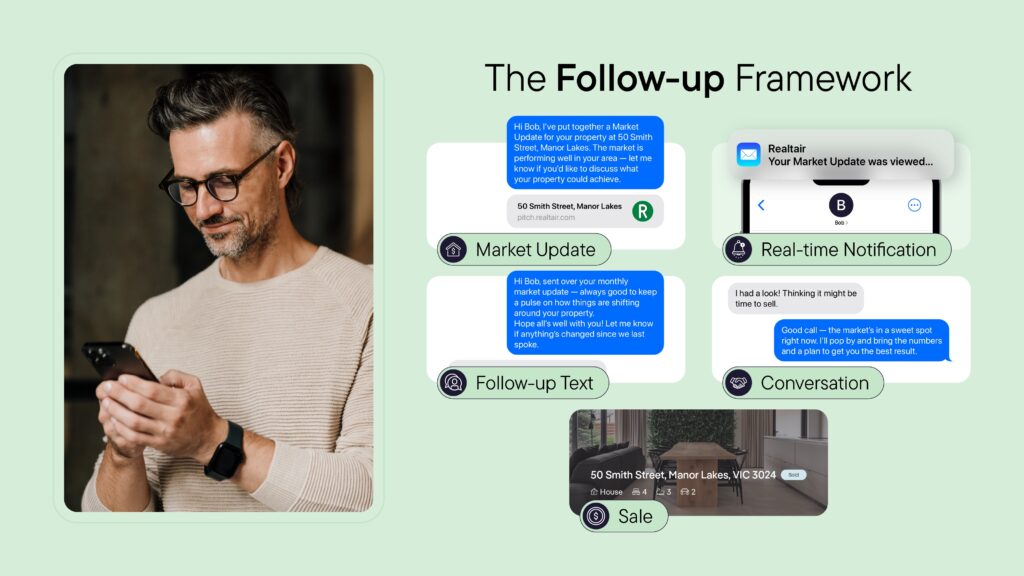
A Market Update isn’t the end of the interaction — it’s the start of a conversation and staying top of mind. The follow-up is simple:
- Confirm if they received it
- Let the dialogue flow naturally
- Move towards the next step if they’re showing interest
Some will say they didn’t see your Market Update, others will thank you, and some will open it right after your call. Every response is a door to further dialogue.
When you position your follow-up as confirming they received something valuable, it shifts the tone. You’re not asking for a favour or pushing for a sale — you’re making sure your “gift of information” reached them. This feels far less intrusive than a cold call and far more genuine.
For most real estate agents, a text message works best. It’s direct, quick to read, and less disruptive than a phone call, and engagement rates are higher than email. A decade or two ago, following up on letterbox drops with calls was possible, but less effective. Today, a personalised text after a Market Update delivers the same intent with better results.
Making It Actionable
Agents who hit their goals understand which activities move the needle and execute them consistently. When each Market Update is worth $500, can you afford not to prioritise them?
1. Create your prospecting plan
Use our GCI Calculator to map your path. Enter your commission target, average sale price, commission rate, and clearance rate. Whether calculating for an individual agent, a team, or an entire office, the process stays the same. Only the activity metric numbers change.
2. Start simple, scale smart
Don’t wait for “perfect” Market Updates before you send them. Taking imperfect action beats waiting to send a few perfect reports. This doesn’t mean sending poor quality content, but many agents over-polish, creating analysis paralysis around colours, layout, or phrasing.
Your focus should be on intent, not perfection. You’re delivering valuable, personal property insights. And with Realtair, your Market Updates are always professional — so you don’t need to sweat the design details.
3. Time-block and protect it
Market Updates are not something you squeeze in when you “find a spare moment.” They are not afterthought activities.
To make them work, you need to treat them like a key business appointment.
- If you’re an associate or newer agent without full listing loads, you should send as many as possible.
- Fifty a day in your first push creates a massive momentum and a strong base for follow-up calls.
- Block 30-60 minutes daily in your calendar, and guard that time. Many offices structure weeks with dedicated prospecting blocks, closing blocks and new business blocks. Model that structure.
This is your pipeline-building work. Protect it.
4. Start with Market Updates, grow from there
Market Updates represent just one component of the Realtair platform. Once you’ve built a consistent Market Update system:
- Move into Agency Agreements through Realtair
- Manage forms, contracts, offers, and auctions all in one place.
- Seamlessly connect prospecting with transactions and closings.
Start small. Perfect the nurturing and prospecting. Then expand into the platform’s broader capabilities.
The Bigger Picture
When you understand the metrics, there’s no room for vague claims about “working hard.” Either you sent seven Market Updates today, or you didn’t. It’s observable, measurable, and manageable.
Raising the skill floor
Agents tend to operate at two speeds when it comes to Market Updates:
- Those who send them sporadically and in low numbers
- Those who send them consistently and in high volumes — and see the results to match.
It’s all about understanding the formula connecting goals to daily actions. Those five raised hands in a room full of agents weren’t more talented. They simply understood which activities actually drive results.
Standing out from competitors
Many agents still send generic newsletters showcasing their successes with properties totally unrelated to the recipients. However, technology adoption in the industry isn’t optional. Agents not adapting to these tools will fall behind, though they might not feel it yet. Implementing technology into your processes now positions you ahead of those who resist.
Turning activity into an asset
Every contact in your database who regularly receives a Market Update becomes a long-term asset.
You’re not just prospecting for today’s listing — you’re compounding your pipeline.
The Market Update builds momentum, creating opportunities months or even years in advance, without needing to start from scratch each time.
Pro tip: Think of every Market Update as a micro-investment. Small daily actions that grow into a significant future return. The compounding effect here is real, measurable, and entirely under your control.
The Mathematical Certainty
Remember those five raised hands in a room full of agents? They weren’t more talented. They simply understood the formula connecting goals to daily actions.
You can hope your way to success, or calculate your way there.
Seven Market Updates daily, proven by a 10% conversion rate from over a million data points, combined with standard industry conversion rates through the funnel. The maths is reliable.
Thirty minutes daily. Seven Market Updates. One system. The question isn’t whether it works — over a million Market Updates sent by agents confirm it does. The real question is: Will you commit to doing the work?